
Ironmonger’s sublime exploration of morality and humanity.
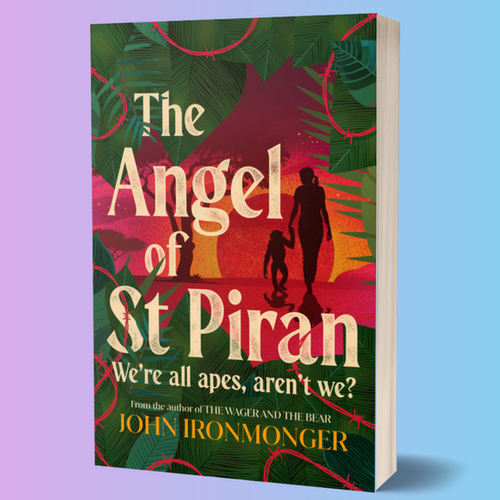
John Ironmonger | The Angel of St Piran | Fly on the Wall Press: £18.99
Reviewed by Paul Knowles and Sam Cassells
Big moral questions lie at the heart of John Ironmonger’s The Angel of St Piran. The novel confronts readers with the contradictory ways humans relate to the animal world. Human characters in the novel have antithetical relationships with animals. On the one hand, there is care, affection and genuine connection with animal species; on the other, there is exploitation, where the animals are stripped of their worth and reduced to resources for human entertainment.
The novel’s protagonist, Angel, has an unusual combination of physical discipline and scientific curiosity – making her the ideal figure through which to explore the boundary between human and animal life. Angel is introduced in the novel’s opening chapters as a local of St. Piran and an elite gymnast who has an ambition to reach the Olympics. Yet her life is not defined by gymnastics alone: she is also studying zoology at the University of Truro and Penwith, where her master’s research focuses on how chimpanzees communicate.
These two passions of Angel’s life collide when Dr. Timothy Cole arrives from Samaki Island. Fascinated by her research, he offers her an extraordinary opportunity to use her gymnastic strength, agility and bodily awareness to live among chimpanzees as part of their colony. The experiment is designed to discover whether chimpanzees communicate in ways that resemble their human counterparts, and it allows Ironmonger to connect Angel’s scientific curiosity directly to her athletic skill.
Before Angel enters the colony, Ironmonger convincingly establishes the physical demands of the task; he is adept at emphasising the strength, agility and courage required to climb, move and survive in the trees through Angel and her coach – they plan how she might ingratiate herself with the chimpanzees. This preparation makes the proposed move to Samaki Island feel both daring and believable.
When the narrative moves to Samaki Island, the reader, like Angel, is whisked away to the research centre at Ranger Island (a small island just north of Samaki Island). There, Angel is introduced to her new human community: Dr Timothy Cole, the elderly researcher and guardian of the island’s chimpanzees; Noah Waziri, a field researcher studying the medicinal benefits of the island’s plants; and Philip, Kobe and Michael, the rangers who protect the chimpanzees from illegal poachers.
This human network is particularly interesting because it mirrors, and at times distorts, the dynamics of the chimpanzee colony. Angel’s arrival alters the balance of both groups. As the only young woman in this male-dominated environment, she changes the atmosphere of the research centre, while the men around her compete, in different ways, for status, control and dominance. These tensions prepare the reader for the novel’s wider interest in power, hierarchy and belonging.
Ironmonger develops these ideas further through his descriptions of the chimpanzee’s habitat in the jungle. Sam and I both loved the way Angel compares her native St. Piran with her new residence – the landscape of Samaki Island: she recognises familiar patterns in the trees and water, yet the island remains strange and unsettling to her. This tension between familiarity and alienness helps the setting feel vivid, immersive and alive.
We are immersed in a natural world that is never presented as the idyllic stereotype; it carries a constant sense of threat. The innate dangers faced by the researchers and rangers on the island are cleverly paralleled by the damage humans (in the case of this book – trophy hunters) inflict on the chimpanzees’ world. Ironmonger uses this alignment to deepen the novel’s moral force, reminding us that vulnerability and danger exist on both sides of the human-animal divide.
This complex relationship between danger and vulnerability is most powerful in Angel’s first meeting with Gaffa, the leader of the chimpanzee troop. We both held our breath as Ironmonger captured the chimpanzees’ majesty and raw physical prowess. Angel’s climbing ability, combined with her willingness to share in their forms of communication — through facial gestures, whoops and guttural sounds — allows her to be accepted into the colony. In time, the chimpanzees come to know her as ‘little bird’.
For a time, this acceptance seems to offer the possibility of genuine cross-species connection. Angel lives in harmony with the colony for two years, until the mysterious conservation group ‘Artemis’ buys the island, closes the research centre and dismisses the rangers. Angel and Noah soon discover that ‘Artemis’ is not the conservation organisation it claims to be, but a shadowy hunting club offering the world’s elite the chance to shoot chimpanzees on the island as trophies, at half a million pounds per chimpanzee.
This revelation returns the novel to the moral questions with which it began. Ironmonger powerfully explores the rationale and logic that have turned the natural world into a site of exploitation, where certain humans revel in dominance over other species. What follows on the island is a deadly fight for survival between the chimpanzees and the hunters. By playing with the hunter-and-hunted trope, Ironmonger raises deeper questions about morality, violence and humanity’s destruction of the natural world.
Sam and I both found Ironmonger’s follow-up to The Wager and the Bear a compelling and fascinating exploration of what it means to be human. The novel offers a sublime meditation on morality, humanity and violence and whether violence should secure physical power and authority. It asks urgent questions about the damage people continue to inflict on the planet in their quest for dominance.
Ironmonger remains one of the bravest and most honest writers working today. He confronts humanity’s capacity for harm without losing sight of more hopeful possibilities. His vision of the future imagines richer, more connected and more loving relationships between humans and animals.
Reviewed by Paul Knowles and Sam Cassells