
At its core, Coca-Cola Lessons illustrates the musings of a poet whose identity listlessly exists between the past and present.
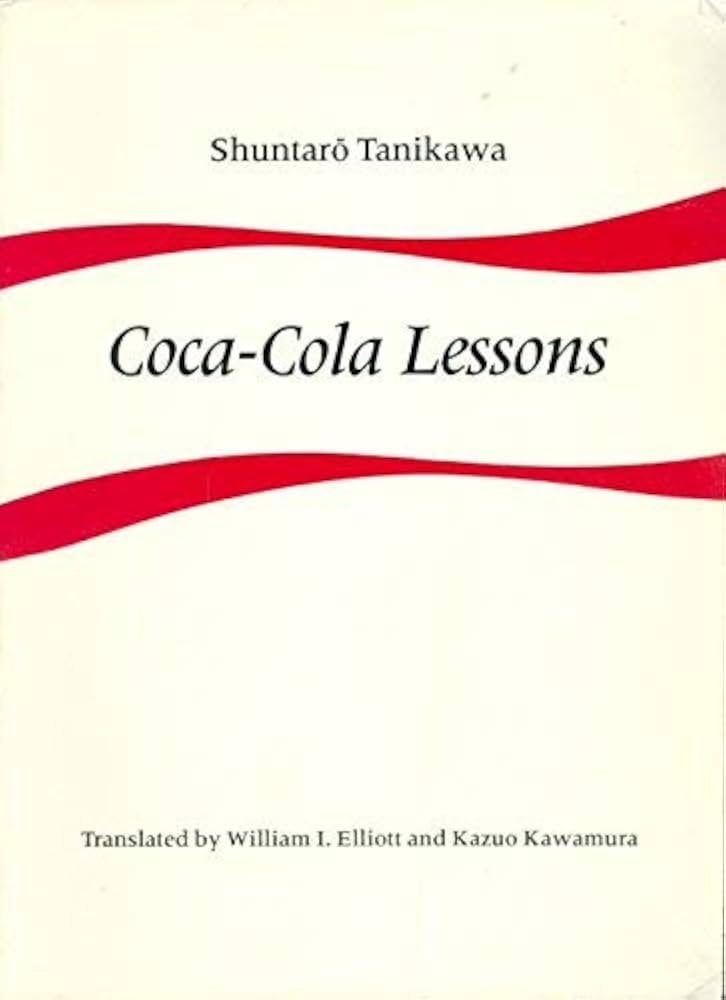
Shuntarō Tanikawa | Coca-Cola Lessons | Prescott Street Press Price: £20
Reviewed by Samuel Philip Kielstra Ortega
Coca-Cola Lessons is Shuntarō Tanikawa’s 1986 poetry collection, translated by William I. Elliot and Kazuo Kawamura. In this collection Shuntarō Tanikawa explores his relationship to the modern 20th century and the bygone early 20th; expressing his dissatisfaction at the disconnect between himself and the present, and the inability of poetry to take him back to the past. It is divided into 14 poems, presenting a variety of monologues and memories from different characters, including that of the poet himself. All of these perspectives are weaved together into a narrative with a poignant, surreal flow. Coca-Cola Lessons asks us to walk alongside Tanikawa in this introspective journey, and do some soul-searching of our own.
One of the key themes Coca-Cola Lessons conveys is Tanikawa’s disconnect with the world around him, and nostalgia for the past. The dissatisfied tone is reflected throughout the language and variety of styles of free verse Tanikawa employs in the poems. In A Day, Tanikawa’s clinical language sinks the reader into the ennui of his day-to-day life, devoid of pleasant imagery which the reader can escape into. Enhancing this emotional absence are one-line stanzas, sometimes as short as one word, that create a negative space that highlights the emptiness of his mundane days. Prose is also used, its bulk mimetic of the derivative buzz of adverts — merely a different form of emptiness. Consistently, Tanikawa presents his existence in the late 20th century as full of drudgery, devoid of ways he can connect to the world.
Contrasting against the drudgery are poems that address memories and childhood, such as Sketches of “Auntie”, or the titular Coca-Cola Lesson. Some of these poems are narrated by the poet, implying an autobiographical aspect to them. Prose is used differently in these poems; with larger paragraphs and rich imagery, they offer a sensory oasis that wanders freely, mimetic of one’s thoughts during self-reflection. Tanikawa presents memories of childhood as a freer place compared to his adulthood in the late 20th. In a similar vein is a third style of free verse: one that imitates the form of more traditional types of poetry.
Appearing sparingly within the drudgery-centric poems, this tradition-adjacent style offers a cathartic release from the greyness; breaking it apart with references to art and culture: the goddess Venus, the Tales of Genji or the oral traditions of a lost tribe. The impression upon the reader is that the past was a freer, more fulfilling time. Reading these lines and feeling once again the emotions the past evoked brings it back to life. Tanikawa, through the reproduction of art via the act of writing, relinks the past to the present, making it surface through the current of time. Despite this success, he also acknowledges the limits of poetry in bringing the past to life. The traditional-adjacent free verse is only an imitation of actual traditional styles, representative of how the past Tanikawa brings back to life is incomplete, limited by the extent to which language can express his feelings. Thus, the past only manages to exist fleetingly in poetry amidst the mundanity of modernity, sinking away into the boundaries of memory, leaving Tanikawa drifting in a modern world he cannot connect with.
This poignant sense of disconnect is reinforced in the arrangement of the collection and the structure of the poems themselves. The collection often makes use of lists to structure its poems, as is the case with Venus Project, which is divided into alphabetical lists. The lists disrupt the flow of the poem, shattering it into many fragments. Tanikawa plays with this to cover a broad amount of topics, perspectives and memories within each poem; paradoxically the disconnect allows him to connect seemingly unrelated topics into a single cohesive whole, as he does in MSS In Progress, where a dream-like nightmare and the mocking, decaying ode of a national anthem sit side by side. The multifaceted depth of the poem’s structure imbues the collection with a very dynamic flow. The juxtaposition between the imagery of MSS In Progress and other similarly structured poems contributes to the surreal sensation that follows us along the collection’s pages.
Simultaneously, the fragmentation forces the reader to pause, and examine each section in detail. We must ponder about why there is a connection between the topics ourselves, mimetic of someone piecing together memories. Thus, the arrangement of Coca-Cola Lessons and the structure of the poems within flows like a collage of thoughts, where we comb through different stills, leading to a timeless, surreal flow. We the reader can feel the same sense of removal that Tanikawa does towards the past and present alike.
Coca-Cola Lesson is a fantastic read, a pleasurable deep dive into the thoughts of one of Japan’s most celebrated modern poets. Its collection of poems presents a microcosm of emotions and perspectives, thematically rich and arranged in an engaging way to tell a cohesive narrative, as if travelling through a surreal mindscape. Ultimately, it is a story told in fragments, of a person exploring his identity in a world he has a relationship with but is no longer a part of; and a world he is a part of but has no relation to. At its core, Coca-Cola Lessons illustrates the musings of a poet, whose identity listlessly exists between the past and present.
Reviewed by Samuel Philip Kielstra Ortega