
Wilson’s masculine autofiction wrestles with inherited violence and literary form in equal measure.
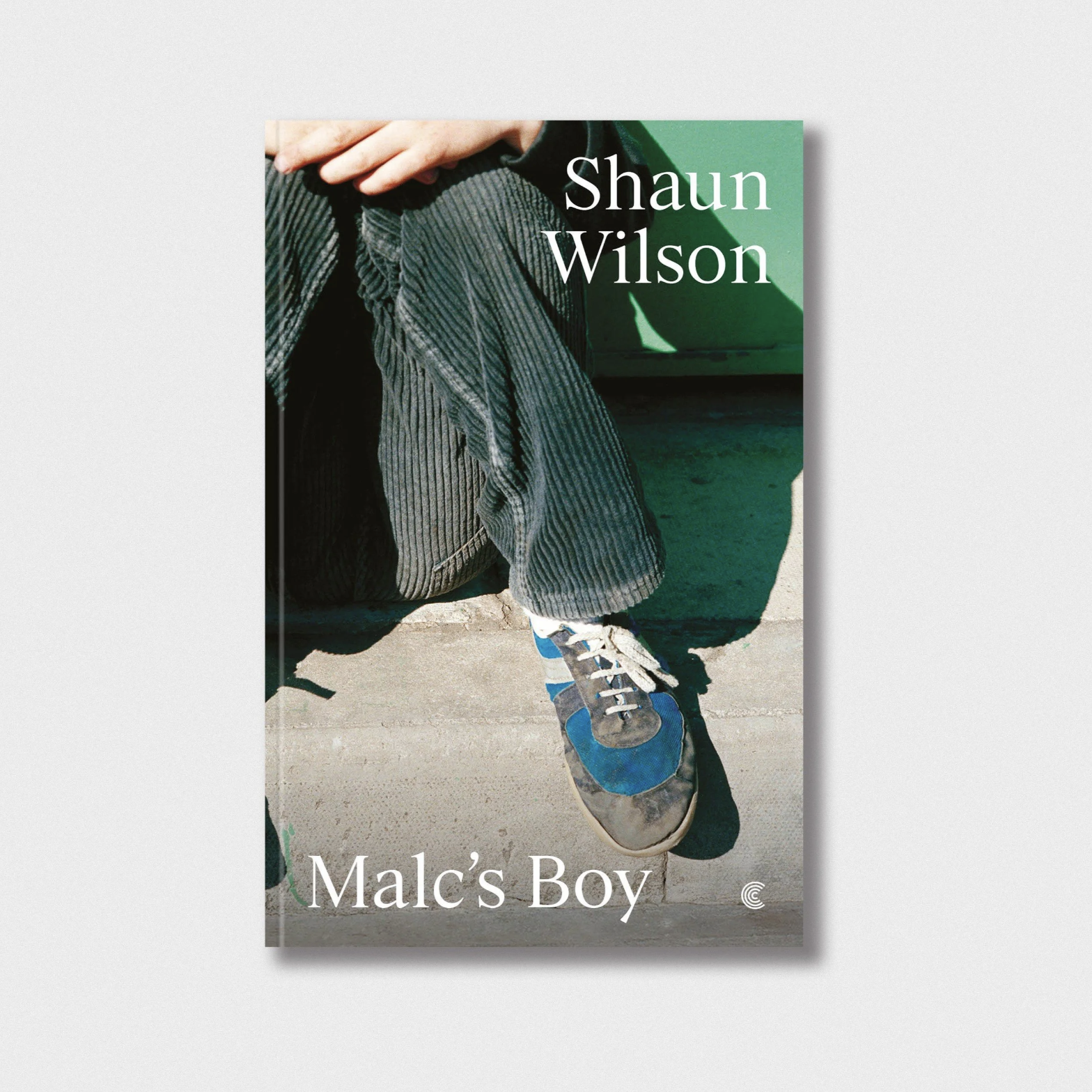
Shaun Wilson | Malc’s Boy | Conduit Books: £12.99
Reviewed by Joseph Hunter
I’ve never been much of a one for fighting. Most of the men I know are the same. I’ve had fights, but mostly when I was very young, and none of them were serious. Violence isn’t really a part of my life in any active way. And yet, like all men, I can’t escape it. The possibility of it lingers. As Shaun, auto-fictional protagonist and narrator of Malc’s Boy, observes: ‘There’s a constant threat uh violence in every interaction between men, it’s underlying all male culture’. The important point to note is that’s whether you like it or not – and most of us don’t. Malc’s Boy is in part the story of how one young man is socialised into violence, through his relationship with his dad, Malc, pub brawler and local hard man. Being the son of such a man, we come to learn, is a heavy burden, and one that sits uneasily on Shaun’s shoulders. This autofiction represents his attempt to understand the nature of his inheritance, one that is arguably shared in some form by all of those raised as men.
Let me step back for a moment and give some context. Malc’s Boy is Shaun Wilson’s first book, and it’s being published by Conduit Books, a new independent press that gained a small amount of notoriety in the literary publishing world when its founder, novelist Jude Cook, announced that the press would have an initial specific focus on publishing male writers, through a desire to combat a perceived contemporary aversion (by agents and editors, the decision-makers in publishing) to the male voice in literary fiction – such voices are often seen as inherently problematic. I should, at this point, confess a personal connection: I submitted my own novel manuscript for consideration by Conduit. I was not successful – in fact, I never even got a reply, understandable when I later learned just how many submissions Cook received from male writers keen to have their voices heard: close to 2,000, in fact. As such I was keen to discover what kind of male voices Conduit would choose to champion.
At first glance it’s perhaps a little surprising that the press has chosen to publish first a book that puts pretty old-fashioned versions of masculinity at the forefront: fighting, shagging, drinking, etc. It does so with gusto. Violence, in particular, is laced throughout the narrative. Shaun’s narration shows how deep this tendency runs in his psyche, with chapter 12 beginning: ‘Stu is my best friend because he’s the second hardest and then Keith he’s the third’ – even the friendships between young boys are stratified by the capacity of each of them for violence. Fighting is often the punctuation in this novel, and it’s a violent episode that forms one of the climaxes of the narrative arc, the now-30-year-old Shaun avenging his ageing father with an act of violence against the man who attacked Malc. This tendency isn’t innate, but either learned (in Shaun’s case), or something that is likened to a demonic possession, coming into Malc from the outside and taking him over:
Malc’s eyes became distant and his face grew pale and dispassionate. It was the vacant, almost sleepy state the boy knew to be a precursor to a certain transformation, as though some aspect of his father’s consciousness was becoming void, readying itself to receive some wandering and malevolent spirit. (p.62)
The above passage is an example of one of several ‘modes’ in which the novel is written. That’s narrator-Shaun (higher level, book narrator) in his literary mode. There are also lengthy passages in free indirect discourse, following the thoughts inside one of the protagonist Shauns (sometimes referred to in third person as ‘the boy’ in chapters that feature a juvenile version of the protagonist), and large sections in Cumbrian and/or Northeastern (mainly Geordie) English dialect. The latter dialects are written phonetically, which takes a little getting used to at first but is pretty intuitive to read. Structurally, the book is divided into 100 short chapters, with dialogue scenes (formatted like a screenplay) between Shaun and Malc interspersing chapters that trace Shaun’s dissolute life, addictions, and sexual encounters – not to mention, of course, the many assaults and fights that punctuate the text.
Adding to this layered picture are the text’s many reflexive, postmodern aspects. This is, after all, a narrative about narrative-making, a text about becoming that we witness in the process of becoming. The dialogue scenes between Shaun and Malc, for example, are explicitly about what kind of narrative Shaun is writing about Malc, thus forming a sort of meta-commentary about truth and authenticity. This device occasionally threatens to get a little too clever for its own good, acquiring what the late David Foster Wallace sometimes referred to as a ‘look mum no hands’ quality:
All we have are the memories an secondhand accounts. Like us now – this is real, isn’t it? It’s happenen now, an it’s bein recorded on there. [Points to the camera, waves.] See – that’s capturen this reality. But then, between now, when it’s happenen, an the time in the future when a’m actually writen it up, transcriben it, there’s a degree uh interpretation there, fer example, this. [Sticks two fingers up at the camera.] A might write that a was sayen fuck off, or a could just say a was hodden two fingers up. Or a could just cut it completely. (95)
For me, such moments stay on the right side of the clever/too clever divide. The text earns the right to be complex and self-referential because the impression we get of Shaun and Malc is that, as complex individuals grappling with ideas of masculinity, they are themselves layered, and often self-referential. The form fits the subject matter.
What it amounts to is that Wilson earns the right to have his novel say things about the male voice that I have rarely seen in contemporary literature. Many of the most direct examples of this appear in the final dialogue scene of the novel, in which Shaun’s interviewee is not Malc but Martine, Shaun’s articulate and feminist partner. Martine takes Shaun to task for his writing not being feminist in several respects, to which Shaun replies:
A’ll admit that me books haven’t got many women in them […] the books a’ve written so far are based on me life, inspired by me struggles wid inherited masculinity, toxic masculinity, whatever ye wanna call it. A’ve tried to keep them lean an just leave the stuff in that’s relevant te the shape uh the book, the plot, even though ye couldn’t call them plots, but shaped around themes uh violence, power, subversion an all that. An women didn’t have a strong role te play in my particular struggle wid inherited violence. (307)
The fact that this has to be stated at all is revealing. A male writer writing about masculinity justifying why his narrative voice and focus is, well, male. A female literary writer would never be criticised for centring female identity, and Wilson seems to be anticipating the inverse criticism of his own text. For my own part, the maleness of this narrative was refreshing and something I connected with, as a man. It doesn’t let men off the hook or excuse the violence they do – if anything, it shows it in its absorbing ugliness. My own – minor – concerns are slightly more subtle. Another aspect of Conduit’s desire to centre male voices is a focus on working-class narratives, of which Wilson’s is one. That’s an admirable aim, but here the working-class story being told – pubs, violence, booze – is only one, somewhat self-destructive and limiting, kind of working-class story. I think of the working-class man I know best, my own dad, who spent his childhood reading and playing football and his adulthood being engaged in leftwing politics, trying to change the world for the better. There are many working-class male voices out there and many models of masculinity to choose from. Shaun Wilson offers authenticity of a certain, compelling, sort, but I hope the violent and rather extreme nature of such authenticity doesn’t become a litmus test for what kind of male story is worth telling.
Reviewed by Joseph Hunter