
Recovery from a severe heart and brain trauma leads to rebirth in the form of a beautifully-narrated renewed appreciation of life.
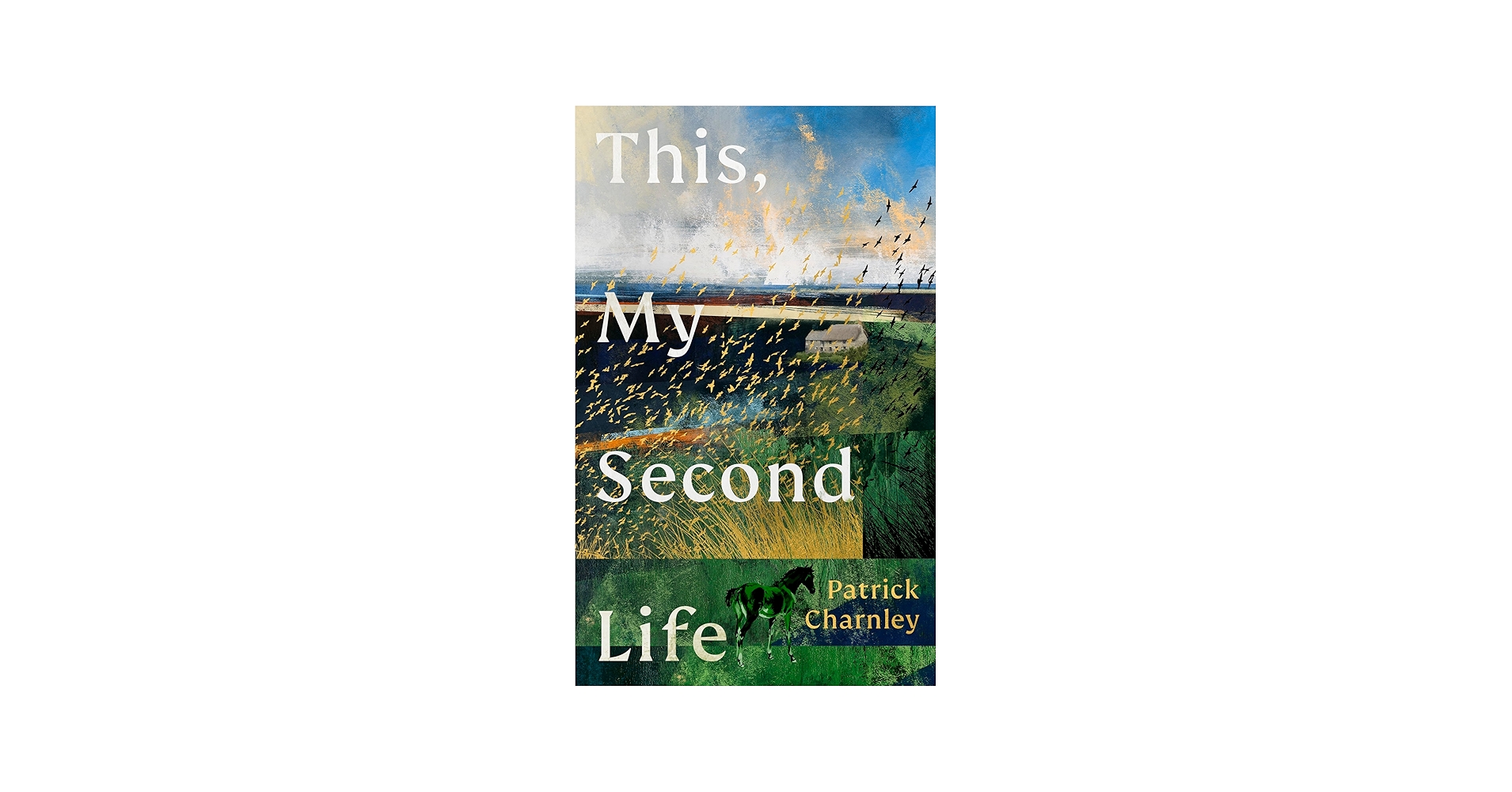
Patrick Charnley | This, My Second Life | Hutchinson Heinemann: £16.99
Reviewed by Nicola Healey
After nearly dying from a cardiac arrest, leaving him with a brain injury, twenty-year-old Jago Trevarno, the narrator of Patrick Charnley’s debut novel, goes to live with his ‘off-grid’ uncle Jacob in Cornwall, where he grew up, to convalesce. His mother died of cancer before his heart attack, and he never knew his father. ‘Clinically I was dead, and for a long time; forty minutes it took them to get my heart going again.’ The two men live a simple, quiet, old-fashioned existence, governed by the rhythms of Jacob’s farm, the natural world and meals, which gently hold Jago within the days as he adjusts to his new life.
The very moving backstory of Charnley’s unusual novel stays in the reader’s mind as the book progresses: in an Author’s Note, he states that everything in the book to do with the cardiac arrest and brain injury ‘is a true representation of my own experience’. Charnley suffered a cardiac arrest in 2021, when he was thirty-nine – the rest is fictionalised. As Jago tells us, ‘Most people who have a cardiac arrest die’, while some are left ‘so badly brain damaged they are in permanent residential care’; so Charnley’s survival and creative new life are extraordinary.
There is an intense spareness to Charnley’s prose, a crisp clarity. Jago’s casual, straightforward voice has a childlike quality, as if everything is being experienced anew, seen through an uncluttered mind; I found this artlessness (in the best sense) very appealing and engaging. ‘I can just sit and not think about anything at all’, he says; ‘before all this I was restless, but now it’s like being a child again, just content in the moment.’
Charnley skilfully depicts the day-to-day realities of Jago’s difficulties, which include memory problems; cognitive ‘processing-speed impairment’, making it difficult to follow more than one-to-one conversations; vision difficulties; cognitive overload and anxiety from over-stimulation; fatigue. Everything he does requires conscious effort, leading to exhaustion.
Unexpectedly, good-humoured Jago isn’t distressed by what has happened to him – he doesn’t feel extreme emotion, neither great excitement nor devastation (the impairment which worries him most): ‘It was as if the brain injury had turned off all my emotions like a switch in my head.’ This emotional levelling comes across in Charnley’s controlled, steady, lucid prose, becoming a literary strength.
There are other positives to Jago’s injury: he is able to wholly inhabit the present moment with greater awareness. Most winningly, he has a heightened appreciation for his immediate surroundings and simple pleasures that we often take for granted. This seems to be a manifestation of post-traumatic growth (as opposed to PTSD). Evocative food descriptions abound – not a meal or snack passes without it being simply but vividly described, often poetically: ‘the butter we make from the milk is almost luminous, like buttercups’. I loved the way he describes piccalilli as being ‘almost as bright as my best T-shirt when I was ten which turned fluorescent yellow when I was hot’. He savours everyday things, his sense-impressions acquiring a gentle radiance, which quickens the reader’s own. The ‘silver skin’ of a large sea bass ‘shimmers like a mermaid’s tail’. The fish is cooked in a ‘salt crust that sparkles in the evening sunlight streaming through the kitchen window’. The prosaic becomes almost transcendent.
Light suffuses the book – the different ways it falls, where it lands – illuminations only someone living at a slower pace would notice, or repeatedly notice. A shaft of light ‘over the kitchen sink cuts across the heavy oak table, picking out all of the scars and dimples in the wood’. When Jago is tending to the cows, ‘Their big chocolate eyes reflect the light coming in through the door behind me.’ Stars are seen as ‘pricks of ancient light piercing the endless darkness’.
Forced by his limitations to live at this slower pace, every act is done with intention. At one point, a whole paragraph deliberately describes the cooking of bacon. This isn’t boring; it’s more interesting, fresh and enjoyable than a lot of more contrived novelistic ‘drama’. Its timeless feel makes this book a great antidote for anyone tired of both technology and hyper-contemporary novels. In the first part of the novel especially, Jago’s conversations with his quiet, benevolent uncle are brief, revolving around farmwork, his wellbeing and simple food – the ritual of buying a cake – lemon drizzle or fruit. One of the things he most likes about his uncle is that ‘The smallest things make him happy.’ Their relationship reminds us that convalescence can be an opportunity to learn how to live better.
Jago is also keenly aware of smells: ‘the ordinary church smell, which smelled of cool still air that wasn’t exactly stale but not fresh either’; the ‘homely’ smell of a library, ‘as if the books have picked up little bits of scent from each home they’ve been in’; and (my favourite) the smell that ‘bursts out of’ straw bales, ‘as if the sunshine was rolled up with the straw’.
The simplicity of Charnley’s observations has a cumulative power, even a hypnotic effect, that deeply moved me: ‘The sheets are cool and crisp’; ‘it had been snowing, and the air, the first fresh air I had felt for weeks, was cold and crisp on my cheeks’. Charnley sustains this distinctive atmosphere throughout the book, cool and bright as that snow-fresh air. One nature observation, during Jago’s stay at the neurological rehab centre, when spring arrives, sparks a Derek Mahon-esque turning point:
I lay on the wall in the garden staring up at starlings swirling and the cornflower-blue sky above. They made me dizzy and I held on to the wall below me. It was in that moment, watching the birds, thinking how they had no idea what had happened to me, that I thought to myself: Everything is going to be all right. Different, but all right.
Nature doesn’t care what has happened to him, and that’s a comfort. Charnley writes insightfully on the mysteries of the brain: ‘the brain is so unlikely. Flesh like the rest of the body, but able to create hopes and dreams, love and desire, ideas and actions. It’s also the great unknown, that much has become clear to me. So much of how the brain works is not well understood.’
As well as Jago’s daily challenges, narrative tension unfolds through the re-emergence of a past love. Until halfway through the novel, Jago avoids going to nearby St Ives, mainly because he doesn’t like crowds and noise: ‘I get disorientated and my head starts hurting. Or maybe it would be too much of a reminder of how life was before my cardiac arrest.’ Once there, he bumps into his old girlfriend, Sophie, whom he had left after his mum died, a bereavement which left him ‘numb’, ‘distant’ and ‘in my own world’: ‘I sort of disappeared into myself’. Charnley writes very effectively on grief: ‘I think maybe I thought that if I wasn’t in St Ives, not with Sophie, and not around anyone else I knew, it could be like Mum hadn’t died at all. […] I think grief made me go a bit mad, and I didn’t know how to undo what I had done.’ The passages where Jago recalls their early relationship are charming, his voice coming alive. This reconnection with Sophie provides the novel’s compelling emotional core: he is forced to re-question his future, what he has lost (both before and since his injury), and what might lie beyond the almost idyllic, yet restricted, existence he has built with his uncle’s support. Movingly, through Sophie, he discovers whether or not the emotional blunting he suffers – which is ‘like part of [him] has died’ – is total.
The shadow plot involving local villain, Bill Sligo, felt secondary to me; Charnley’s careful re-creation of Jago’s inner struggles holds enough drama and interest of its own. And while the book’s dream-like ending might feel sentimental, it is the remarkable qualities of this novel that stay with the reader.
One of this book’s great strengths is that it gently makes the reader much more aware of what people go through with a brain injury. As Charnley states on his website, ‘Every 90 seconds someone in the UK is admitted to hospital with a brain injury’, yet ‘few people know about brain injury and the enormous impact [it] can have on a person and their family and friends’. Jago says his ‘second’ life is ‘so contrary to everything I’ve known so far in my life about illness. You get ill and, if you don’t die, you get better. […] It’s different with this brain injury’ – as it is with other, less extreme, chronic conditions or invisible disabilities. Wellness and illness are not binary states.
It was a further surprise to learn that Charnley is the son of the poet Helen Dunmore, who died of cancer in 2017; this gives added poignancy to what her son has uniquely created out of his life-changing injury.
The way Charnley’s family, neighbour, paramedics and other medical professionals managed to save him feels more like a resurrection than a resuscitation. This profoundly affecting, memorable novel would be an impressive debut if it was written by anyone, but that it is written by someone enduring the effects of a brain injury, who was clinically dead for forty minutes just five years ago, makes every page feel almost miraculous.
Reviewed by Nicola Healey