
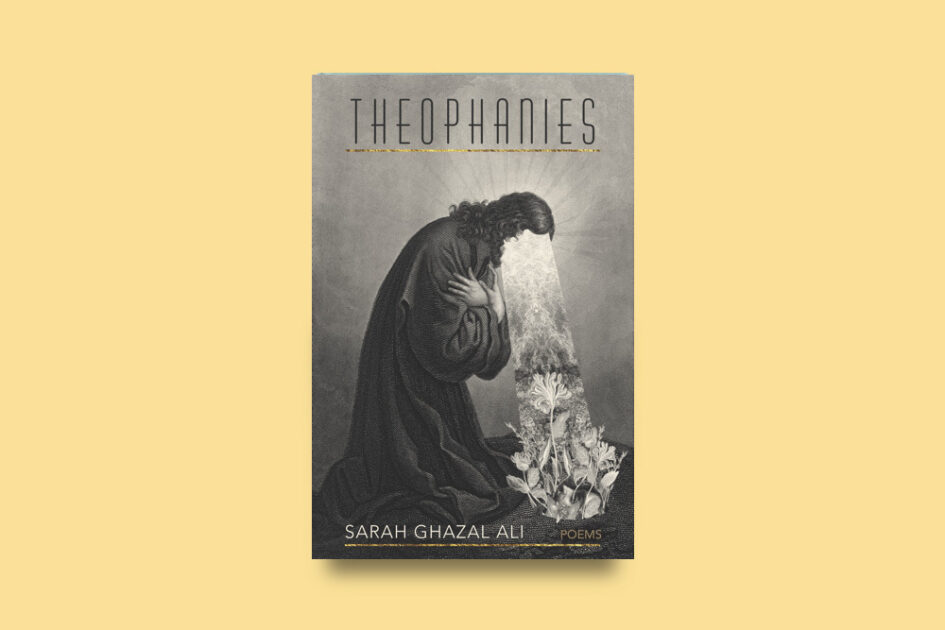
Sarah Ghazal Ali | Theophanies | 87 Press: £14.99
Reviewed by Ian Pople
Ghazal Ali’s book discusses what visible manifestations of God – or a ‘theophany’ – might mean in a feminist context. She draws on both Muslim and Christian perspectives on women’s relationships with God; in particular, how those perspectives might sit in a contemporary context.
In this collection, Ghazal Ali’s approach is signalled in the very first poem: ‘My Faith Gets Grime under Its Nail’. As the blurb comments, ‘[Ghazal Ali] asks: what more might a woman’s body hold after it has been hailed as a body for the divine?’ This first poem is a short, stand-alone sequence in which Ghazal Ali tells us about the ‘places I’ve prayed – elevators, Victoria’s Secret / fitting room, the muck-slick meadow after rain – / which will testify for or against me, spilling through my Book of Deeds’. Each section of the poem is prefaced with a surah from the Qur’an; section three is prefaced with ‘Say, I seek refuge with the Lord of Dawn.’ This is followed by, ‘One a month blood roams / like mint over immaculate grass,’ and later, ‘let the angels in // to spectate the ache / and erase a sin for every devoted cramp.’ So, we can see that Ghazal Ali’s own perspective is to place what have traditionally been quite taboo areas of a woman’s experience, in a sense, before God and the angels. The earlier mention of Victoria’s Secret implants a contemporary female context within that perspective. Thus, the woman’s body that Ghazal Ali depicts is contemporary in ways that ‘the body for the divine’ might, perhaps, elide.
It is clear that Theophanies focuses on triangulating the female body with the sacred and divine. It should be emphasised that Ghazal Ali does this with considerable power and imagination. ‘Parable of Flies’ begins with, ‘I heard them, wings beating / a din beyond the thistle, pilgrims / beckoned by the promise of carrion.’ And its final stanza is, ‘I’m divining my body a dirtied domestic. / When it rains, devotion is the womb / I’ve hollowed to keep desire dry.’ Of course, to hollow out the trajectory of the poem in the way I’ve just done is to undermine the subtle contrasts Ghazal Ali is making.
‘Parable of Flies’ traces that trajectory from the flies’ so-called ‘pilgrimage’ in the second line through to the ‘devotion’ and ‘desire’ that Ghazal Ali finishes with. In the middle of the poem, that trajectory is ‘an economy of asylum’ from ‘my body a dirtied domestic’, which is where ‘devotion is the womb.’ The womb is a place of devotion not only to the God that Ghazal Ali is devoted to, but also a place of creation away from the sullying of the outer world. Elsewhere, however, the poem ‘Tumulus’ ends ‘O Maryam, / is birth not its own / inhumation, / did your child not emerge / perfectly alive / and written to die?’
This sense of an inevitable teleology in a woman’s life pervades this collection: ‘Apotheosis’ begins:
Listen-if I’ve learned anything from men,
It’s that their tongues are bare
and motherless, lapping the breast of brawn
they mistake for a masculine God.
And it ends,
I know nothing of God’s plan or the invasive empires
of devotion, gardens I waste away wanting.
I fell heir to my father’s hands, anguish, eyes-
the crimes of men beget the crimes of men.
Between these two points, Ghazal Ali plots a path that includes beheading, passing a date pit from her mouth into the mouth of her lover, the possibility of assault, and the inevitability of her submission in a man’s world. However, there is also the sense that ‘[her] faith in God was inevitable as an oil spill.’ Thus, Ghazal Ali juggles the secular, with all its threats and opportunities, almost in parallel with the religious. It is a testament to her skill that she is able to do this while allowing both those spheres to work together. This unity is personified for Ghazal Ali in the life of Maryam/Mary, the mother of Jesus, whose life Ghazal Ali places at the forefront of many of the poems in this book with great adroitness and musicality. Sarah Ghazal Ali’s Theophanies has now found a British publisher after receiving a slew of prizes in the US.
Reviewed by Ian Pople