
Femi Elufowoju Jr’s adaptation of Rigoletto for Opera North brings a dark psychological edge to Verdi’s masterpiece.
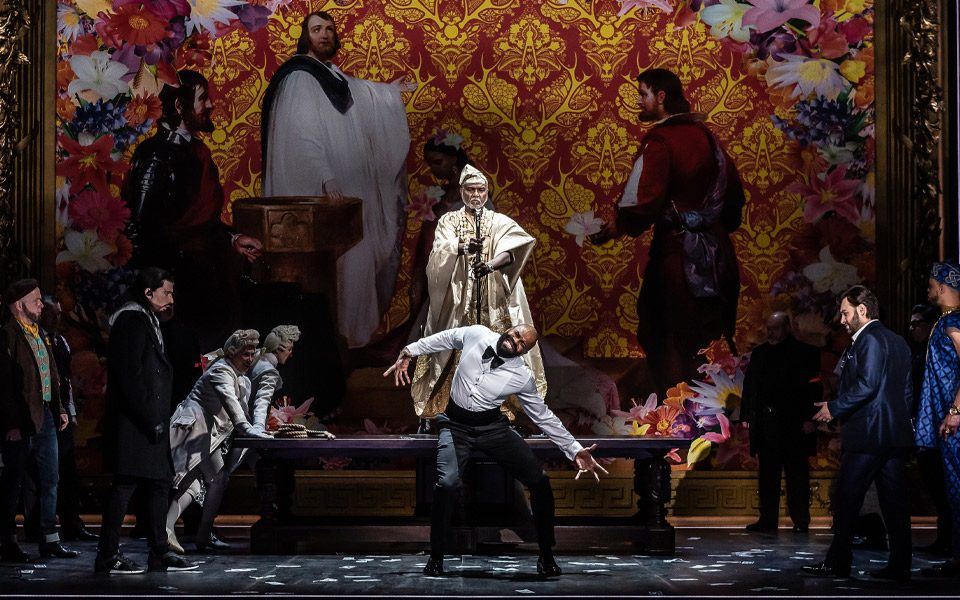
Rigoletto by Opera North | The Lowry, Salford | 18th October – 20th November
Reviewed by Paul Knowles
Ahead of the performance, the director of Opera North visited the stage to showcase the company’s endeavours to bring opera to everyone. Of particular pride to her was its educational role in exposing young people to the art form: a mission of vital importance at a time when the arts are vying for attention and appreciation in education and public life. Attention that seems ever diminishing.
Femi Elufowoju Jr’s award-winning production of Verdi’s Rigoletto seeks to make the opera relevant to modern Britain through its depiction of race, identity and exclusion. In the original Rigoletto, its protagonist’s otherness is defined by his physical deformity, drawing upon Victor Hugo’s Le Roi s’amuse and recalling the physical marginalisation found elsewhere in Hugo’s work. In Elufowoju Jr’s production, however, Rigoletto’s otherness is centred on his race and his exclusion from the predominantly white court of the womanising and morally corrupt Duke of Mantua. Elufowoju Jr wants to “focus on how exclusion and inequality shape the characters’ behaviours”, and this idea runs through the production.
It is this psychological focus that gives the opera its intoxicating sense of self-destruction. There is something almost Lear-like about Rigoletto: his obsessive desire to control his daughter’s life, combined with his hunger for revenge and justice against the duke, ultimately destroys everything he holds dear.
The production opens with a psychological fizz. The stage is framed by strips of white light: a solitary white chair sits centre stage against a black background. A stark contrast to evoke an emotional connection to Rigoletto who is deep in thought, seemingly contemplating the morality of serving a ruler like the Duke of Mantua. The starkness is suddenly replaced by a vibrant party at the duke’s court, where Rigoletto stalks its edges — simultaneously belonging and not belonging — while the duke flirts with wild abandon.
Verdi’s opening score perfectly captures the frenetic quality of the party and the duke’s predatory lust. Thomas Elwin plays him with gleeful relish, capturing the moral corruption of a man whose wealth and power have insulated him from the consequences of his actions. There are moments in Verdi’s score when the violins are masterfully shrill and the wind section reaches an unsettling crescendo, skilfully accompanying Rigoletto’s unease as an outsider. A jester (expected to entertain them with lusty humour and tolerate the savage put-downs of the husbands and fathers of the women pursued by the duke) who is not loved but bayed for by the crowd.
That position is crucial. Rigoletto is both victim and participant. He suffers exclusion at the court while simultaneously weaponising cruelty against others in order to secure his own precarious place within it. Elufowoju Jr’s production is at its most interesting when it refuses to make that contradiction comfortable.
The next scene takes us to the safe house where Rigoletto has hidden his daughter, Gilda, in an attempt to protect her from the wickedness of Mantua’s court. The duet between Rigoletto and Gilda is breathtaking, capturing both a father’s overwhelming, possessive love and a daughter beginning to rebel against parental control.
Under Anthony Hermus’s commanding direction, the Orchestra of Opera North imbues the duet with moments of quiet restraint and sudden uplift that capture Gilda’s growing desire for independence and for a life beyond the narrow boundaries of home and church. The staging reinforces her innocence: her room is filled with greenery, colour and vibrancy. Unbeknown to Rigoletto, after he leaves, the duke enters the house and professes his love to Gilda while disguised as a poor student. Here Verdi’s music is full of vigour and youthful exhilaration, capturing the breathlessness of first love as Gilda falls for him.
The scene ends with Gilda’s kidnapping by the men of the court, who mistakenly believe that Rigoletto has hidden away a lover and delight in the prospect of humiliating him. The greenery and vibrancy of Gilda’s world give way to red. The windows and doors of the house are breached by the kidnappers, and the sudden porousness of the set becomes a fitting metaphor for Rigoletto’s psychological degradation. The sanctuary through which he hoped to control and protect his daughter was never impermeable. Neither, ultimately, is his own mind, increasingly invaded by jealousy, vengeance and the corrosive effects of a lifetime spent on the margins.
Two later scenes confirm Blake Denson’s performance as the psychological powerhouse of the production. The first comes when Rigoletto confronts the courtiers who have kidnapped his daughter. His anger gives way to despair and then pleading. Denson captures the terrible isolation and impotent rage of a man who has never truly been accepted by the people whose approval he nevertheless desires. His thirst for vengeance is not simply an individual moral failing. It emerges from humiliation, loneliness and exclusion, even as the opera refuses to excuse the destruction that reaches its culmination in the final scene, when Rigoletto discovers that his quest for vengeance has brought about the loss of the person he most desperately wanted to protect. The moment is filled with pathos, pain and heartbreak. His tragedy lies partly in the fact that love and control have become indistinguishable to him. In trying to seal Gilda away from a corrupt world, he has helped produce the circumstances in which that world destroys her.
Opera North’s Rigoletto is therefore also a reminder of why live performance matters. Opera can sometimes appear remote: expensive, historic, linguistically unfamiliar and associated with forms of cultural privilege that can make it seem closed to precisely the audiences Opera North is trying to reach. Elufowoju Jr’s production demonstrates why that need not be the case. It takes a nineteenth-century opera and makes the questions of race, belonging, sexual power, inequality and social exclusion feel intensely contemporary without sacrificing the emotional and musical force of Verdi’s work. A production such as this offers another kind of argument.
Music, theatre, literature and art give us ways of recognising ourselves in the experiences of other people. They confront us with moral contradictions rather than easy answers. They allow us to encounter beauty and cruelty, love and possessiveness, belonging and exclusion, often simultaneously.
Reviewed by Paul Knowles