
Is it really Zuckerberg’s power that we should fear, or the uncontrollable nature of a product that seems to govern itself?
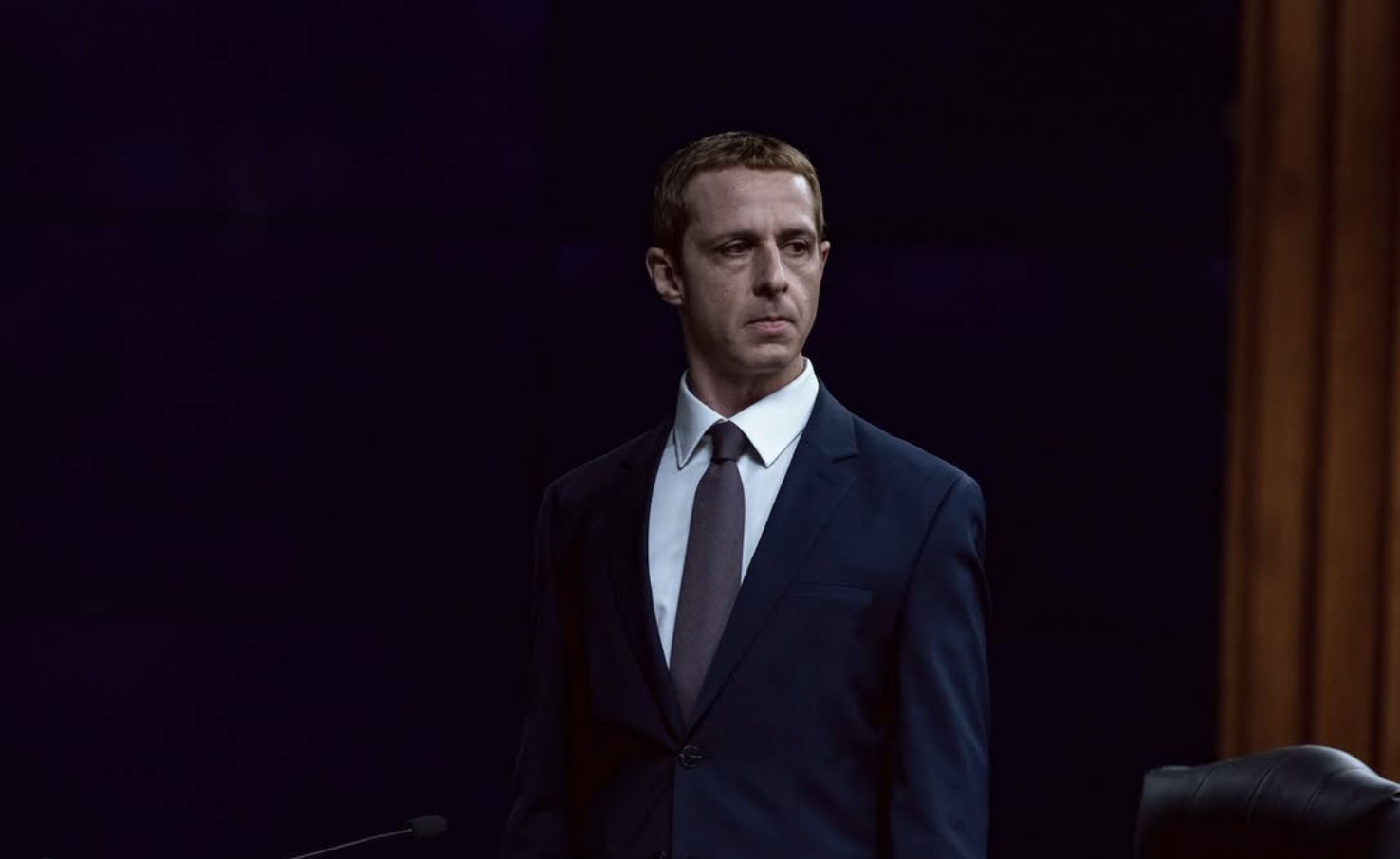
The Social Reckoning | dir. Aaron Sorkin | Reviewed by Devarya Singhania
Social media has gotten dangerous. I know, shocking! Besides the flood of news updates we receive, from data leaks to increased advertisement spam, it’s no secret that social media manipulates our lives in unprecedented ways. Aaron Sorkin’s The Social Reckoning examines the 2021 Wall Street Journal exposé on Facebook, which revealed the changes in the platform’s algorithm, responsible for fueling more hate content.
The movie begins with a white woman abusing the cops, after they check up on her pulled over car and allege her for drunk driving. Not only does she record herself and the cops as the altercation follows, but she also spews bigoted and racist comments. We have no context about who this woman is at this point, nor is it ever confirmed whether she was drunk. She eventually gets arrested after she threatens the cops, and the movie shifts to the Facebook story from there.
When Frances Haugen (Mikey Madison) is introduced, she’s presented as a relatively quiet and underconfident employee. She’s anxious when trying to ask questions about the algorithm to the head of media relations (Billy Magnussen), and once he denies her the opportunity to do so anyway, she simply resigns to the idea. Trusting this to be a real life incident, reported factually and accurately, it’s quite interesting how invisible she appears. Right off the bat the viewer knows anyone who works at Facebook, unless the head of some department, is disposable. Voiceless, even. If this wasn’t a true story, and the whistleblowing wasn’t a documented fact, I don’t know if I’d have believed this character to have been gutsy and careful enough to out-manoeuvre Facebook’s internal systems and report the files to Jeff Horowitz (Jeremy Allen White). There’s no indication of that fire and rebellion within Frances, that one might associate with a whistleblower.
As Jeff’s involvement with the reporting gets more active, Facebook’s ‘Civic Integrity’ team gets more alert. The Civic Integrity team, as the viewer understands, was created to protect the users’ interests over the company’s. The team is told to avoid Jeff at all costs. And why not? Why won’t the team, designed specifically to restrict the harm done to users, actually supply the reporter working on that cause with the necessary information he needs? Unless, of course, the whole team was just a public relations exercise? Isn’t it then risky that an employee such as Frances can run tests and access information about the company that exposes and contradicts the very notions about safety it publicly claims?
After a series of secure messaging, mostly to no replies, Jeff is sent a message by Frances, and they begin working together. Frances clarifies that they aren’t on the same team, and that she intends to help Facebook (she loves her job, after all), to which Jeff obliges. This is where we learn that the white woman from the first scene, who was now “radicalised” from Facebook, was actually Frances’s batchmate once. Aren’t reunions fun?
This is where my frustration began to develop as I watched the movie. This isn’t a spoiler necessarily, but the whole process, literally every step of it, is so easy for the two of them. They encounter absolutely no friction in their procurement of the documents. As a viewer, you won’t even believe for a second that they will fail, or get found out way before than they have to. Of course, I know this is a true story. And if the whole process was as smooth in real life, I can’t expect Sorkin to fabricate the tension. But it was also hard to believe that Facebook, this giant corporation with infinite resources (as described in the movie), did not have even a sliver of an idea that this was happening under their noses.
And sure, I think it was fitting to portray Mark Zuckerberg (Jeremy Strong) as an oblivious, self-indulgent tech bro, who could only outsource troubleshooting to his employees. He’s treated like a baby by the crisis manager (Wunmi Mosaku) and Charlie Garrigan (Bill Burr) as he prepares for his senate hearing. You look at Zuckerberg in the movie and wonder how this man could be in charge of a trillion dollar company with such immense power and control over our lives. But I’m not sure if Sorkin established that contrast well. One minute Frances and the other employees are absolutely terrified of even looking him in the eye, and the next he’s this socially awkward and almost helpless, AI-bot-esque person when talking about free speech (as the trailer shows, he calls himself a free speech “absolutist”). I really wanted to believe the idea that he’s not as wise as we make him out to be, even though he emits this fearful aura towards the people at Facebook. But I couldn’t quite do that. Sorkin’s depiction seemed confused about the approach it wanted to take. I think there was an inclination to show more of Zuckerberg’s cluelessness, but the demeanour of everyone around him (except Charlie), and his stoic body-language suggested that the viewer should recognise his power.
But is it really Zuckerberg’s power that we should fear, or the uncontrollable nature of a product that seems to govern itself?
The movie ends with the Jan 6th riots taking place, with Zuckerberg and his team deciding what to do about Trump’s account. Although Zuckerberg denied any responsibility of Facebook with the riots a few months after it all happened, Sorkin is successful in getting that horrified, guilty look in his eyes as Zuckerberg looks at the events unfolding. It is at this moment that my personal favourite frame of the movie, and in my opinion, also the film’s most powerful image is captured: Zuckerberg sits in front of lines of codes, auto-updating themselves, as the riots play in the background. The powerful billionaire, a “visionary” is reckoning with an alleged consequence from the issues Frances had identified.
No matter how careful you are with social media, turns out, its invisible mechanisms are a step ahead. Whatever the powerful people are supplying it with, to keep you on the site for longer, is working. Even if you come out angrier, frustrated, and with a motivation to transfer that harm to another person, in real life.
Reviewed by Devarya Singhania