
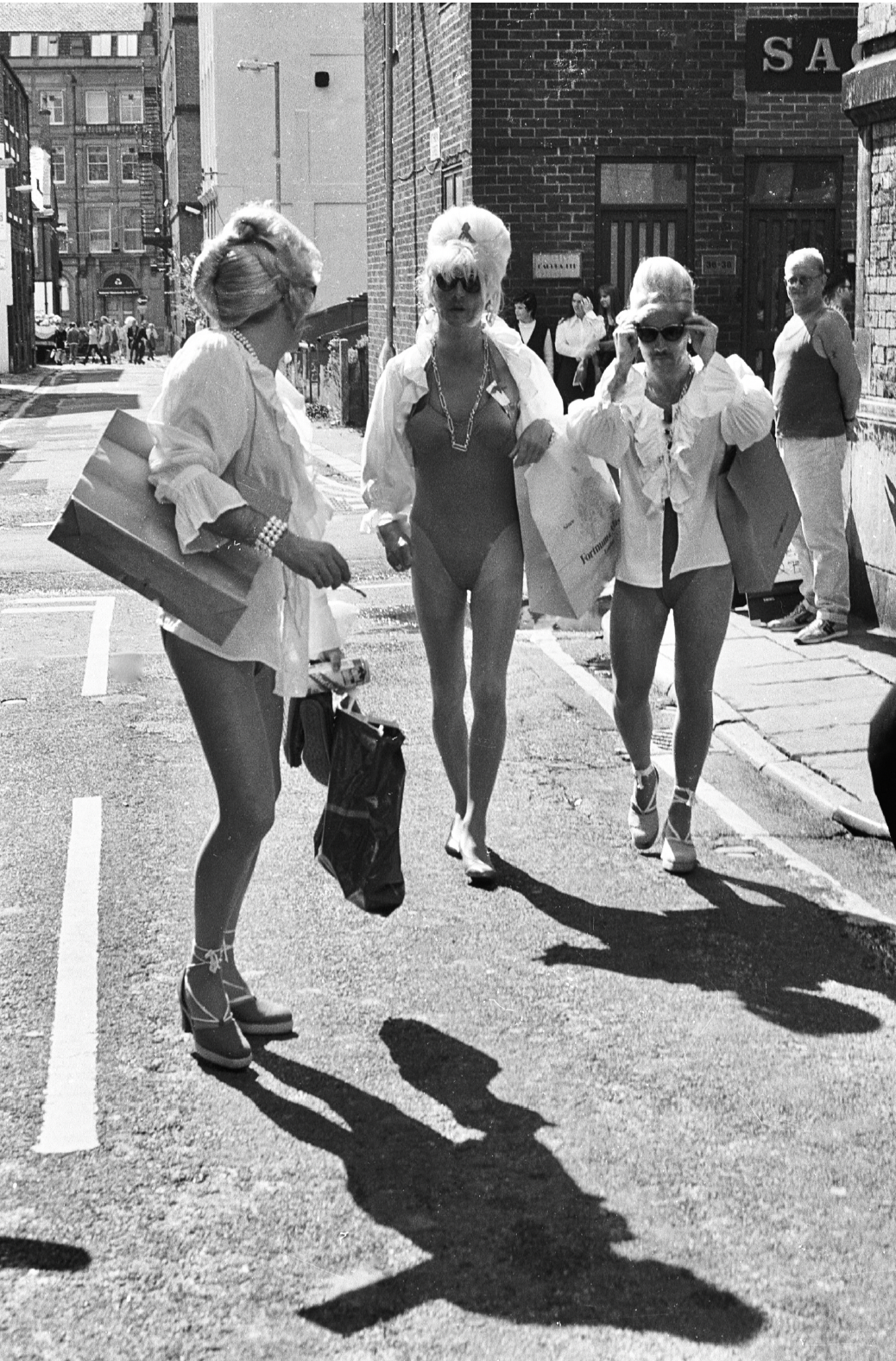
Image: © Charles Eastwood
On 19 March 2003, US and British forces invaded Iraq; by May the Guantanamo Bay detention camp in Cuba had become a permanent facility housing over 680 prisoners. In Europe, a devastating heatwave caused over 30,000 deaths that summer. The year also saw the launch of Skype, Linked-in and the MySpace social network, as well as the introduction of Blu-ray DVDs.
In November, shortly after Nina and Maryam had completed the purchase of their very first flat, Nina sent out an email inviting everyone to their house-warming party. It would also be an Eid dinner, she said, marking the end of Ramadan. Warning: there would be NO alcohol.
Mel read the message and laughed as all the replies bounced in. ‘No alcohol? WHAT!’ ‘Are you serious?’ There were questions, too, and Nina answered them patiently. No, there wouldn’t be any praying, and, no, Maryam wasn’t particularly religious but her culture was important to her and you couldn’t have people getting pissed at Eid, that would just be disrespectful. ‘Bring soft drinks,’ Nina wrote.
Mel’s sister Paula was on the phone right away. ‘It’s a test, Mel. Nina reckons this will sort the sheep from the goats. We have to be there.’
Of course they were going, said Mel. Danny worked with Maryam and Nina, he saw them every day. ‘Are you bringing Francis?’
There was a little silence. ‘He’s pretty busy with rehearsals at the moment,’ Paula said. ‘He may not be free.’
That was apt, Mel thought.
It was hard for Mel to see Paula in love. She was used to her sister’s sarcasm, her brassy toughness, but to be around Paula when she was with Francis – to see her so soft and pliable, laughing, leaning towards him, even blushing (blushing!) – made Mel afraid for her. He was so much older than the rest of them, and openly bisexual, which Paula said she was fine with. To Mel, though, it was like seeing a creature without its shell, or a soldier walking naked into battle.
In the early days of Paula’s bedazzlement, Mel had gone with her to see Francis play Lear in a tiny fringe production which, Paula was at pains to point out, he was only doing as a favour to friends. (‘Normally you’d see him in much more fabulous company.’) That evening Mel saw his true power. For eighty minutes, he held them captive in the inky dark, his voice rising and falling, gathering in intensity, then dropping to a near whisper, eyes raking the blackness. Whenever he left the stage there was a palpable loss of pressure, like a sigh. And Mel understood: Francis was a bright, bright light and Paula was the moth.
On the night of the party, Nina’s directions led Mel to a council estate thrown up in the early 1980s, depressing to look at from the outside, all tarmac and weeds, but the location – ten minutes from Waterloo, twenty from the river – was fantastic.
At the entrance to the block, she spent some time fruitlessly pressing buttons and waiting for the lifts to arrive until a red-faced woman came clattering down the stairs carrying a pushchair with a baby strapped inside. ’They’re out of order again, love,’ the woman said, slamming the pushchair down on the path. ‘I’ve reported it, but you know what they’re like with repairs.’ The baby began to cry. The mother stuffed a pacifier in the child’s mouth, then launched herself and the pram at a group of sullen youths who were milling about on the path. The young men scattered into the misty November evening and the woman disappeared.
Mel began to climb the stairs. Housing was her mind because her landlord had given her and her housemates two months’ notice saying he wanted to sell the place. They knew he probably just wanted to splash a bit of paint on the walls and double the rent, but there was no point in arguing. She and the others were all scrabbling to look for alternatives, every woman for herself. ‘You could move in with me,’ Danny had said. It was true that he had a nice room and his flatmate was hardly ever there, but they’d been together such a short time. Could you really say you knew someone after only eight months? ‘What if we argue?’ she’d said. ‘Then I’ll go and sleep on the sofa.’ But he didn’t push it. ‘It’s up to you.’ She just wasn’t sure.
At the seventh floor Mel left the enclosed stairwell and found herself on a long open walkway with doors on one side and on the other side a view of more blocks in the same style.
‘Am I the first?’ she asked when Nina opened the door.
‘God no. There’s three of them in there, cooking up a storm.’ Nina gestured towards what was presumably the kitchen where Mel could hear the clatter-clang of plates and pots and cupboard doors. ‘Go and say hullo.’
‘I want a tour first.’
From the hallway, there was a short corridor leading to a bathroom, a loo, and two smallish bedrooms. ‘Nice,’ said Mel. They went back to the large sitting room, which Nina was busy decorating with garlands of paper flowers. Beyond that was a balcony. ‘Nice,’ Mel said again, and she meant it. The place was sparsely furnished but it belonged to the two of them. What a relief it must be to know that no landlord could ‘just pop in’ to check that you didn’t have pets or blu-tack on the walls or ask you to move at the end of a year’s lease.
Soon Danny arrived, rumpled and a little grey in the face after a day of teaching but smiling. Mel’s heart gave a pleasurable skip. Hearing his voice, Maryam came bursting out of the kitchen, releasing clouds of steam and the smell of spices. ‘You made it!’ It was sweet to see how pleased she was to see him. Danny was good at friendships with women, comfortable in female company. This, thought Mel, was one of his very good points.
‘Come and meet the others!’
There were two other guests in the kitchen, chopping and stirring things, both wearing aprons. Danny seemed to know Rukhsana – also a teacher – but not Fazia, who worked in the City. Maryam introduced Danny as ‘our lovely music teacher colleague’, while Mel was presented simply as ‘Paula’s sister’. Danny glanced over at her and winked.
Mel unloaded a litre of apple juice and a packet of shop-bought cakes from her bag, then felt embarrassed when she saw what the others had brought. There were piles of delicious looking samosas and onion bhajis from Rukhsana. And Fazia, who lived near Brick Lane, had brought a big box of hollow crispy golden globes called puri. Even Danny had managed to pick up an exotic fruit salad.
The puri, Maryam explained, would be filled with a teaspoonful of crunchy chopped vegetables, some tamarind chutney, and a splash of spicy ‘water’ (pani), then eaten in a single bite. These particular ones were special because they combined the three major flavours of Asian cooking in one mouthful: the spicy, the tangy and the sweet.
‘Just like our Mel here,’ Danny said, slipping an arm around Mel’s shoulders, and the others laughed.
Maryam’s friend Nikisha arrived next, bringing a litre of diet coke and a bag of pick ’n’ mix sweets from the pound shop in Brixton, which made Mel feel better about her own contribution.
Maryam was showing off the dessert: a big glass bowl of spiced milk pudding. ‘Sheer khorma. My mum used to make it every year for Eid. What am I saying “used to”?’ Maryam winced. ‘It’s probably sitting in her fridge right now. They’ll be eating it later, just like us.’
Fazia touched Maryam’s arm. ‘Don’t think about all that right now, piyari.’
Ever since Maryam had moved in with Nina there’d been a rift with her family. Bad enough that Maryam was in a relationship with a gora, a white person, her mother had said, but a gori, a white woman? No, that was too much. It would kill her father if he knew. She was not to breathe a word of this to him. Her brother had said other things, just as bad if not worse, so pompous, so self-righteous. Maryam said she didn’t want to see them until they were ready to accept her as the person she was, not who they wanted her to be.
‘You’re right, Fazia.’ Maryam nodded. ‘Tonight is a celebration.’
Nikisha went off the living room to plug her iPod into the speakers and dance music flooded the flat. She came twirling back to the kitchen to help herself to slivers of vegetable from the chopping boards. She lifted the lid of a pot on the stove, leaning down to sniff the simmering contents.
‘What are you doing!’ Maryam slammed the lid back down again. ‘You must never open the lid on a biriyani! Crazy girl.’
‘Sorry, Babes. My bad.’ Nikisha flicked her dreads and danced off again, and Maryam went back to salting slices of fat purple aubergines to leach out the bitter juices.
Danny folded Mel into an embrace. ‘Good to see you,’ he whispered in her ear. She laughed. ‘You saw me this morning!’ ‘Too long ago,’ he said.
By the time Paula arrived, apologising, delayed by with some crisis at work, all the pani puri had long since been eaten. Maryam turned down Nikisha’s music and declared that it was time for the main meal, and they went through to the kitchen to fill their plates from the array of dishes laid out on every surface. There was an aubergine biryani made with saffron, rose water and cashew nuts; turmeric-yellow Bombay potatoes flavoured with lime and fresh coriander; crispy pea and lentil cakes; sticky, spicy, garlicky chicken wings and lamb chops for the meat eaters; a big dish of pilau rice; stuffed parathas, naans and rotis; cucumber and mint raita; a row of chutneys; and a big pot of dal made from yellow split peas still simmering on the stove.
Returning to the sitting room they perched on cushions, beanbags, upturned boxes, wherever there was space, and for a while there was silence, broken only by groans of appreciation at the food. ‘Come sit with us,’ Nina and Maryam called to Danny, claiming him for their little group. From the other side of the room, Mel watched him covertly: his curly brown hair getting a little long at the collar, his lightly freckled skin, his grey-green eyes, his elegant musician’s fingers. He was laughing at something Nina had said.
‘At least he’s not your usual type,’ Paula had said when Mel first told her about him. ‘Meaning?’ ‘Meaning chilly guys with zero interest in you. Normally you go for that kind of bloke like a wasp at a picnic.’ It was true. Danny wasn’t cold and he made no secret of the fact that he liked her. ‘I never get tired of being with you,’ he’d said to her the other evening. Why did that make her hesitate? She was like Groucho Marx, reluctant to join a club that would welcome her as a member. It was ridiculous, but true. I’m just not ready yet, she said to herself. Not right now. She’d only just started her MA course. She needed space where she could spread out without bumping into someone else’s arms and legs, their stuff, their moods. And she didn’t have family to fall back on if things turned sour. All sensible reasons. But at the back of her mind she heard what she knew Paula would say: You’ll never be ready, will you? You hate change.
Danny looked up and caught her watching him. He tilted his head, smiling a quizzical smile. OK? he mouthed. Mel blushed. All good, all good, she signalled back. And it was. Why did she find goodness so difficult to embrace?
‘Is Francis coming?’ someone asked, and Paula said, ‘Probably not.’
Nevertheless, Mel noticed that she put aside a plate and cutlery for him, ‘just in case’, together with a few samosas, a roti and a naan, since these were always gobbled up, and every time the doorbell rang her head jerked up at the sound. As the evening wore on, bits and pieces of Paula’s store were cannibalised by her neighbours, and by ten o’clock – when quite a few people had left already – she’d given up hope and let her neighbour take the last of the rotis. Just then, Francis arrived.
He knew how to make an entrance. Tall and rangy with that powerful, craggy face, he paused on the threshold long enough to have everyone turn to look at him. He ran one hand through his mane of iron-grey hair, nodding greetings to the people he knew, and to Maryam he said, ‘Eid Mubarak,’ with a courtly half bow. He’d probably looked that up on the internet, Mel thought.
‘Khair Mubarak.’ Maryam beamed, accepting the bunch of roses he held out to her. ‘Thank you.’
Francis picked his way across the room to where Mel and Paula sat. He laid a kiss on the top of Paula’s head, then dropped down to sit on the floor, near but not exactly with her, and turned the beam of his attention outwards to the people he hadn’t met before. To Fazia he said: ‘An American bank? Gosh. Is it as relentless as everyone says?’ to Nikisha: ‘Teaching assistant? You must have so much patience. I’m sure you deserve a medal.’ And to Rukhsana: ‘Physics!? What can I say? I failed science at school. I’m not even qualified to kiss the hem of your garment, madam.’
Maryam brought him a plate of food. Francis leaned back against the wall as he ate, long legs tented in front of him. Paula moved closer, not quite touching.
‘So, tell us about this play, Francis,’ Maryam called across the room. ‘You’re in rehearsals?’
Francis began telling them about the elderly star who couldn’t remember her lines. One by one, the smaller conversations broke off and people turned towards him, drawn in by the easy flow of his stories. Mel watched Danny on the other side of the room. He didn’t demand attention in the same way but he was his own kind of star. He played keyboards in a jazz ensemble and banjo in a smaller, crazier outfit that he loved best. She thought of the last gig she’d been to, watching the way he moved, the way he put all of himself into the music, the way some of the women looked at him afterwards.
‘… last week, she jumped straight from the beginning of Act One to the middle of Act Two. Absolute nightmare. But her name will bring the punters in – all those coach trips from Surrey and Kent. And she’s a marvellous woman. Talk about charisma. We’re all more than half in love with her.’
Only Rukhsana and Nikisha carried on murmuring, heads are close together. When Francis paused to take a bite of samosa there was a silence and they heard Rukhsana’s voice, low and upset: ‘…and the lift just emptied when he got in. Everyone else got out.’
‘What’s this?’ Francis asked.
Rukhsana shook her head. ‘Nothing.’
‘It’s not nothing,’ Nikisha said angrily. ‘She’s talking about what’s been happening to her community since all this crazy stuff about ‘the war on terror’. Politicians and the papers keep chatting shit and making trouble for people. Her parents’ neighbours used to smile and say hullo. Now they cross the street when they see them coming. Her uncle’s been spat on. Her auntie’s family had graffiti on their gate.’
‘But that’s appalling!’ Francis looked at the faces around the room, his gaze flickering from one to another. ‘Shocking.’
What was he really thinking? Was this just another of those quirky insights he gained from hanging around with Paula, a bit of ‘research’ that might one day get used in a role? Sometimes Mel thought he was simply a tourist in their lives and one day he would have learned all he needed to learn from them and then he’d be gone.
‘OK, so the twin towers thing was bad,’ Nikisha was saying. ‘But it wasn’t Rukhsana’s fault or Rukhsana’s parents’ fault. The papers don’t go on like this when white people do bad stuff, do they? In America when they have those shootings, nobody starts looking funny at all white people, do they?’
‘True enough,’ Francis said carefully, ‘although I have to say it was the same for the Irish in the 80s and 90s when the IRA were planting bombs on the mainland. You may be too young to remember that time.’
‘Are you Irish?’ Nikisha asked with a touch of aggression.
‘Is that important?’
Nikisha was frowning. ‘Even if you were and that was happening to your community, you’d have a lot more options. You can keep your mouth shut, or you can change your accent. You’re an actor, aren’t you? And you’re white. People like me and Rukhsana and Maryam, we can’t change the colour of our skins. And it’s worse for the men. Way worse.’
Rukhsana nodded. Her brothers didn’t dare go out with a rucksack these days, she said, because people would assume they were suicide bombers.
There was a silence.
‘O, this country!’ Nikisha burst out. ‘I wish I could go and live somewhere else.’
‘Where, though?’ said Rukhsana.
Nikisha looked lost.
‘Let’s change the subject,’ Paula said. ‘Nina, why don’t you tell us–’
But Maryam clapped a hand to her mouth. ‘The sheer khorma!!’ she exclaimed. ‘I’ve been so busy talking I forgot to serve the sheer khorma!’ She glanced around the room. ‘What a shame. So many people have gone already.’
‘Never mind,’ said Nina. ‘It’s not too late. We’ll fetch it out now.’
They went off to the kitchen and Maryam returned carrying the big glass bowl of milk pudding beautifully decorated with candied fruit. She paused in the middle of the room while Nina went around distributing bowls and spoons, and she began to explain how this dish was traditionally eaten in the morning after the Eid prayer and then served to visitors throughout the day. ‘And this one has pistachio and almonds and –’
From outside on the walkway there was a sudden eruption of noise: yells and a violent pounding at the front door. Maryam dropped the bowl and it shattered at her bare feet. Behind her in the kitchen came an answering crash from the window. Everyone was up now. Mel could feel her heart pounding in her chest.
Nina didn’t hesitate. Small as she was, she sped to the front door, threw it open and pelted off after the attackers. They could hear her yelling, ‘Come back here, you bastards! Come back you cowards!’ Danny ran after her, Paula followed, and then Maryam, too, walked out in a daze, leaving a trail of milky pudding footprints streaked with threads of blood.
‘Let’s clear this up, shall we?’ Rukhsana muttered.
Mel, Fazia and Rukhsana went into the kitchen. There was glass in the sink and all over the floor. Mel went back to the sitting room with a plastic bag and some kitchen roll to scoop up the mess from the floor while the other two swept up in the kitchen.
Outside, the commotion had brought the neighbours onto the walkway, tutting and offering sympathy, many of them in dressing gowns and slippers. An elderly man fetched a sheet of plywood and helped Nina secure the kitchen window, which had had a half brick thrown through it. His wife said it was very likely the work of a small group of teenagers – ‘A bad lot’ – and not to worry, not to take it personally. Another neighbour called 999. And when they said they couldn’t send an officer till the following day, he said to knock on his door if they needed a statement.
Maryam was inconsolable.
‘Don’t take it personally?’ She stood in the kitchen, reviewing the damage, laughing and crying at the same time. A few of the pots on the counter had been covered but most of the dishes were contaminated with glass. One by one, she picked up the containers and with trembling hands she began to scrape the food into the bin.
‘What is this if it isn’t personal? Whatever their reasons, it was you and me they attacked.’ She turned to Nina. ‘How can we carry on living here? How can we ever feel safe again?’
Mel watched as Nina drew Maryam into an embrace and the two of them stood rocking from side to side. ‘This is our home, Maryam. We belong here as much as anyone else. We’re not moving.’ But Maryam wept and wept for a long time afterwards as if the broken window had punched open a floodgate of sorrows.
In the early hours the friends who remained, including Francis to his credit, wrapped themselves in blankets and sleeping bags and lay down on the floor of the sitting room so that for one night at least Nina and Maryam wouldn’t be so alone.
Mel curled herself around Danny, drawing as close as she could. Thinking back over the evening, all her doubts and hesitations about him seemed ridiculous now. Too kind? Too fond of her? Too good? You couldn’t have too much goodness in a world like this. ‘Yes,’ she whispered. ‘I will.’ But he was already asleep.
2004 saw the launch of Facebook. Vapes became commercially available for the first time, and Dutch company, TomTom, began to sell the first satellite navigation tool made for domestic customers. From January 2004, all foreigner nationals entering the USA were obliged to have their fingerprints and pictures taken. The project to map the sequence of the human DNA code was completed. The year was declared to be the fourth warmest on record since instrumental data began in the late 1800s.
____
Vicky Grut’s short fiction has been included in two volumes of Salt’s Best British Short Stories, in 2019 and 2026, and her collection Live Show, Drink Included was shortlisted for the Edge Hill Short Story Prize in 2019. Her work has been Pushcart nominated in the States and she was selected as one of The Masters Review Best Emerging Writers in 2024. She teaches creative writing at the City Lit Institute in London. www.vickygrut.com / @vickygrut.bsky.social